Aqua Life Guard RO Range: Which Model Fits Which Home
The right purifier depends on your incoming water, daily demand and installation conditions—not simply its stage count. Here is how to compare models without relying on unverified specifications.
Choose a purifier whose documented treatment capability matches your water test results, with enough usable storage and production capacity for your household. There is no verified model catalogue or specification sheet available here, so naming a particular Aqua Life Guard RO model as the best fit would be misleading.
Aqua Life Guard is an independent multi-brand provider in Kanpur, not an authorised brand service centre. Treat an “aqua life guard ro” search as a starting point for comparing actual branded models, rather than assuming it identifies a manufacturer’s product range. Ask for the exact manufacturer, model number and current manual before deciding.
Match the treatment to your incoming water
Start with the source: municipal supply, borewell, tanker or a changing combination. Source type alone does not establish quality, and no single treatment recommendation applies to every Kanpur home. A suitable laboratory test can help identify the contaminants that your purifier needs to address.
A handheld TDS meter measures an estimate of dissolved solids; it cannot establish whether water is microbiologically or chemically safe. BIS IS 10500 specifies an acceptable TDS limit of 500 mg/L and a permissible limit of 2000 mg/L in the absence of an alternate source. These figures are not all-contaminant safety guarantees.
Consider RO where reducing dissolved salts or specific contaminants is necessary, checking the model’s documented reduction capability and feed-water limits.
Where dissolved salts do not need reduction, assess whether a suitable non-RO system can address the identified treatment need.
Do not assume UV or UF removes dissolved salts, or that a higher stage count proves better treatment.
Match capacity and storage to household demand
Count drinking and cooking demand rather than selecting by family size alone. A smaller household with frequent guests may need more reserve than a larger household with modest demand. Compare usable tank capacity and rated production separately: the tank supplies stored water, while production determines how quickly it refills.
Actual production can differ from the advertised rating because of inlet temperature, pressure and water characteristics. Use the manufacturer’s stated test conditions and operating limits when comparing models.
For modest daily use, prioritise appropriately sized storage, straightforward servicing and accessible consumables over unnecessary features.
For higher demand, check whether refill capacity can support peak use as well as total daily consumption.
If water or electricity availability is intermittent, assess usable reserve and refill opportunities; avoid oversizing storage without considering turnover and the manual’s hygiene guidance.
Check installation fit and ongoing maintenance
Before buying, safely inspect the proposed location without dismantling plumbing or electrical equipment. Check space, service access, a suitable water connection and an appropriate drain route. Have a technician confirm inlet-pressure compatibility, mounting requirements and any manufacturer-approved pressure-control accessories.
Compare ownership costs using written information for the exact model. Ask about replacement-filter availability, membrane costs, service charges and any stated warranty terms. Do not infer these from another model or an oral description.
Follow model-specific filter, sanitisation and storage instructions; maintenance also depends on usage, incoming water and performance changes.
Request assessment for recurring leaks, unusual noise, persistent low output or unexpected taste or odour changes. Do not open powered or pressurised housings.
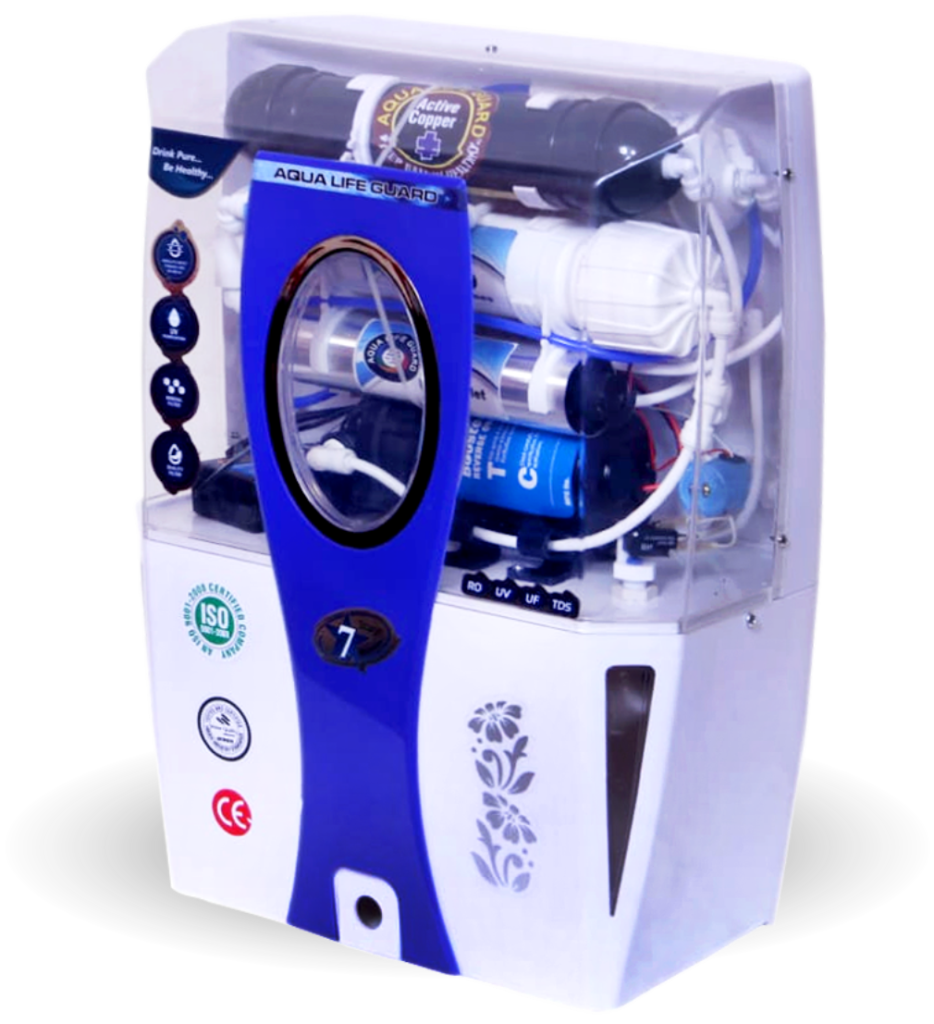
Treat copper, alkaline and mineral features as specifications to evaluate—not evidence of health benefits or water safety.
Make the final comparison evidence-based
Shortlist models only after checking water-treatment needs, capacity, installation compatibility and ongoing costs. A technician can assess equipment and installation; a laboratory is needed to investigate contamination concerns. Neither a sales demonstration nor a TDS reading replaces appropriate testing.
For an enquiry with Aqua Life Guard at 302 Barra-II Main Rd, Sector 4, Barra 2, Kanpur, bring available test results and approximate daily demand. Request written model specifications before committing. Without those details, a model-by-model recommendation chart would imply evidence that is not available.
FAQ
Questions from Kanpur customers
Need RO Service in Kanpur?
Tell us what's wrong with your RO purifier and we'll help you find the right service.